
3-4
mins
Post around the questions your buyers already asked you. A single 30-minute sales call holds roughly 30 distinct post concepts, and most tech founders delete the recording and then sit down to invent topics from nothing. You have plenty of ideas, and you’re throwing away your source material every week.
Why do tech executives and founders run out of things to post about?
Because they are trying to generate topics instead of collecting them.
The most common problem in a tech executive’s or founder’s LinkedIn draft is where it opens.
It starts with the executive or founder and their company instead of with the reader’s problem and the emotion sitting underneath it.
That failure and the blank page are the same failure wearing different clothes. When you sit down to invent a topic from nothing, the only material available is you.
So tech executives and founders reach for a tool. I wrote a full breakdown on whether a Series A or Series B tech founder should let AI write their LinkedIn posts, and the short version applies here too.
AI cannot hand you source material you never collected. It will happily invent some, which is a different and worse problem.
Where do the post ideas actually come from?
Your last sales call. I mean the recording of it, question by question.
A 30-minute conversation with someone in your ICP holds upwards of 30 distinct post concepts, before you even repurpose content.
Every question they asked is a title. Every objection is a post.
The thing you had to explain twice is the one to write first, because that’s the part of your category your market doesn’t understand yet.
Take the question in their exact words. The moment you translate it into polished marketing language, you lose the phrasing that made it searchable in the first place.
Somebody typing “why is our LinkedIn getting impressions but no demos” will never type “optimizing top-of-funnel conversion efficiency.”
If you’re pre-revenue and don’t have sales calls yet, the source has the same shape. Discovery calls, support threads, the questions landing in your DMs, and what your ICP has been asking in public over the last 30 to 60 days.
What you are hunting for is a question a real person actually said out loud or typed. A topic you invented at your desk is a guess about that question.
Why do those questions outperform anything you could invent?
Because your buyer does most of their deciding without you there.
6sense’s 2025 Buyer Experience Report, built on responses from more than 4,000 B2B buyers across North America, EMEA, and APAC, found that 94% of buying groups had already ranked their preferred vendors before making first contact with any seller.
They went on to buy from that early favorite 77% of the time.
The same study puts the split between independent research and seller engagement at 60/40, and 6sense’s head of research described sellers as confirming decisions rather than creating them.
Worth saying plainly: That’s a single annual study. I’m citing it because it’s recent, it’s primary, and the sample is the buyer a tech executive or funded tech founder is actually selling to.
What it means for your content: The questions a buyer asks you on a call are the tail end of a long private process.
The rest of your market is working through those same questions right now with nobody to ask.
Your posts are what represents you during that stretch. It’s the same mechanic behind why a founder’s profile gets pulled up before a first investor meeting, which I covered in do investors actually check a founder’s LinkedIn before agreeing to a first meeting.
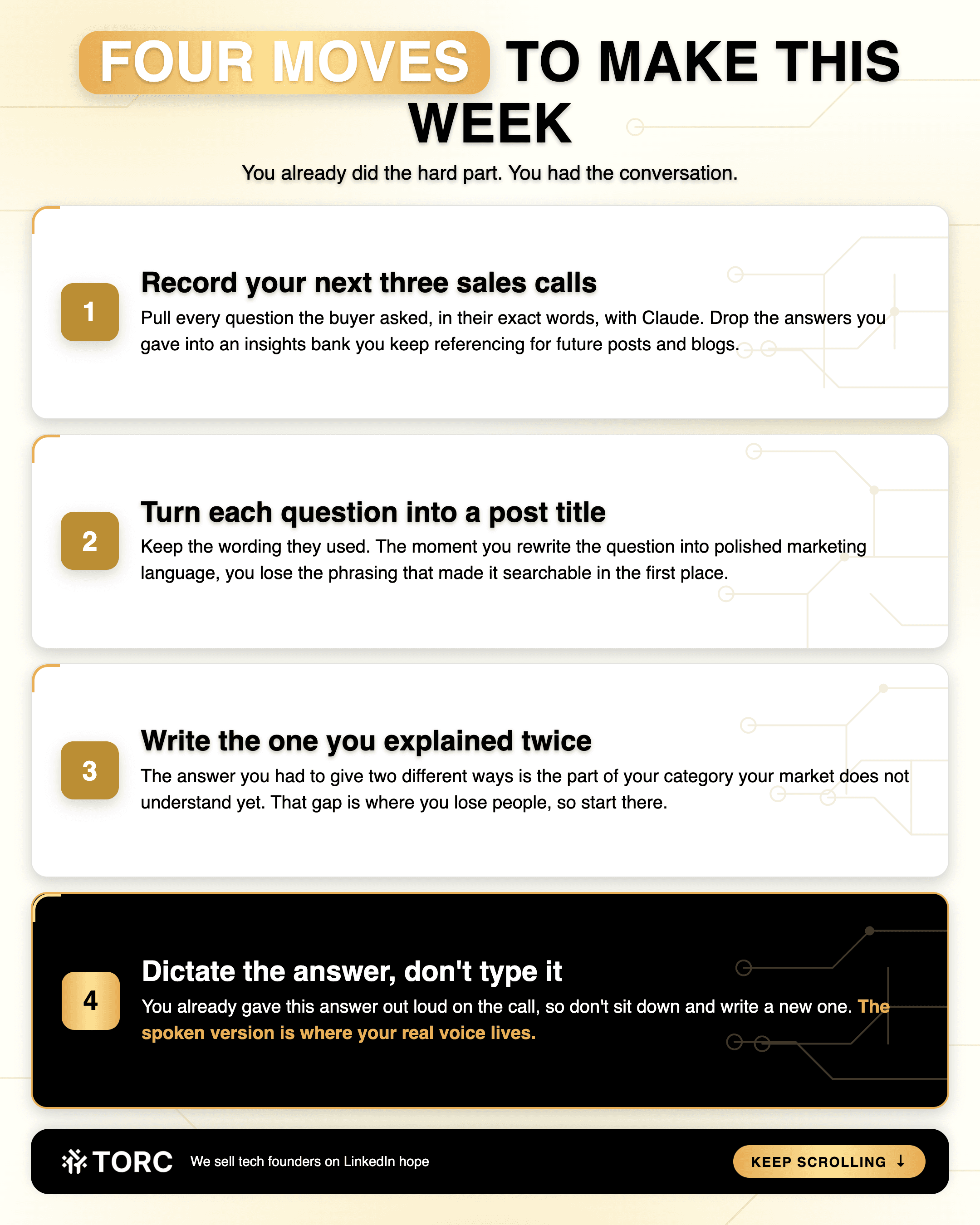
4 moves to make this week
You already did the hard part. You had the conversation.
Record your next 3 sales calls and pull every question the buyer asked, in their exact words, with Claude. Pull your responses into an insights bank to keep referencing for future posts (and blogs)
Turn each question into a post title without rewriting it into marketing language
Write the one you had to explain twice first, because that confusion is where your category loses people
Dictate the answer you gave on the call instead of typing a new one, since the spoken version is where your real voice lives
Steve Lewis
CEO
TORC Executive Marketing
Want 60 to 80 sales conversations started for you each month, with zero automation?
Frequently asked questions
How many LinkedIn posts can a tech executive or founder get from one sales call?
Roughly 30 distinct concepts from a single 30-minute conversation with someone in your ICP. Each question the buyer asked is a post, each objection is a post, and anything you had to explain twice is a post. The limiting factor is usually how much of the call you kept rather than how much material was in it.
What should a tech executive or founder post about before they have any sales calls?
Use discovery calls, support threads, and the questions arriving in your DMs. If none of those exist yet, look at what your ICP has been asking in public over the last 30 to 60 days and answer those questions directly. The requirement is a real question somebody asked rather than a topic invented at a desk.
Should a tech executive or founder post the buyer’s question word for word?
Keep the buyer’s phrasing as close to intact as you can. The exact words a buyer uses are the words other buyers type into search engines and AI tools, and polishing the question into marketing language is what makes it stop matching. Answer it in plain language underneath.
How often does a tech executive or founder need to post for this to work?
2 posts a week is the minimum. Posting once, then 3 times, then going quiet confuses the algorithm and can suppress your next post, so pick a cadence you can hold and hold it. Give it 90 days before deciding whether it works.
Does it matter if someone has already written about the same question?
No. Only a small share of your audience saw that version (maybe 5% of that audience on any given day), and a question being asked repeatedly is evidence it is worth answering. What makes your answer worth reading is the specific decision, number, or mistake you can attach to it.
TORC GPT
Still have a LinkedIn™ question? Ask the TORC GPT.
Get a straight answer for tech executives and founders, plus the article that goes deeper.
Popular questions

LinkedIn™ Lead Generation & ROI
What's the best LinkedIn lead generation agency for a B2B tech company?
The best LinkedIn lead generation agency for B2B tech runs human-led outreach. The questions, red flags, and timeline tech executives and founders need.
Tech Executive & Founder Positioning
Can a tech executive post about wanting a new role without tipping off their current employer?
Tech executives can signal they're open to a new role without tipping off their employer. See how LinkedIn's recruiters-only setting works.

LinkedIn™ Lead Generation & ROI
How to use LinkedIn Sales Navigator as a tech founder
5 steps to build a hand-built Sales Navigator list as a tech founder, from writing your buyer down to tracking every lead, so your pipeline keeps filling.