
3-4
mins
About 800 for every month you plan to run, and since LinkedIn outreach needs 90 days before it shows pipeline, that puts the real starting number near 2,400. Active is the word doing the work. Someone who hasn’t posted in the last 30 days isn’t on your list, however well they match the title.
There are some exceptions to this. We have seen leads get generated for some of our clients as soon as week 6 with our conversation generation package.
Where does 800 a month come from?
Start with what you can physically send.
A warmed-up account runs somewhere around 800 connection requests a month at full speed. You can’t send to the same person twice.
That means 800 sends a month burns 800 names off your list, permanently. Your list is fuel you consume.
LinkedIn won’t tell you the exact limit. The company’s own help documentation says it keeps invitation limits in place to protect the member experience without publishing a number, and warns that an account restricted for having too many outstanding invitations may have to wait up to a month before it can send again.
Month 1 is cheaper on your list than the months after it. You open at roughly 100 requests a week and build to full speed across 3 or 4 weeks, which lands month 1 closer to 400. Months 2 and 3 run the full 800.
If you haven’t been active, LinkedIn will typically cap you at 100 per week. After you’ve earned the platform’s trust, you can then ramp up to 200 per week. You typically won’t get suspended or banned if you hit the limit, but it’s best to avoid hitting it every single week to rule out any possibility of it.
90 days is the minimum before any of this shows up as pipeline. Judging LinkedIn sooner is like going to the gym 3 times and deciding it doesn’t work.
Round the whole thing to 2,400 and you have margin. Walk in with 600 names and you’ll hit an empty list around week 7, wondering why your messaging suddenly stopped converting.
If your send volume has already been throttled, read why a LinkedIn connection request limit drops before you blame the list.
What does “active” actually cut from your raw list?
This is where the number most tech founders bring me falls apart.
Active means they posted in the last 30 days (Sales Nav filter). Anyone who hasn’t isn’t really on your list, however perfectly they match the title.
If you get desperate, you can start reaching out to people who are at least commenting once or twice a month. That means they’re on the platform, even if they’re just there to scroll. That requires a lot more manual sifting. Just don’t expect a quick response.
You can’t mail someone who doesn’t have a mailbox. Sending to people who last posted a year ago is volume with no prospect of a conversation behind it.
Pull an old contact export and roughly 20% of it survives that filter. A 3,000-name CRM list you’ve been sitting on is closer to 600 usable people.
That’s under 1 month of send volume, from a list that felt like a head start.
2 other things thin a list before you notice.
Some job titles are barely on the platform at all. Physical security roles, for one, show up far less than their information security counterparts. When a target title produces nothing for weeks on end, the role itself may simply be missing from the platform.
Geography does the same thing. A smaller city means a smaller list, because LinkedIn density doesn’t track population the way a search engine does. A market that looks addressable on a map can have almost nobody reachable on the platform.
We’ve had to have these conversations with clients that people in Hot Springs, Arkansas, just aren’t as targetable as leads in Miami. Big cities are big lead hubs.
Can you narrow so far that the list runs dry?
Yes, and I did it to myself.
When I started, I targeted only tech executives. AT&T, Intel, and Accenture sat on my background, so I figured it was a done deal.
6 months in, the pool ran dry. Only a fraction of that group posts at all, and the rest are genuinely hard to find.
1 buyer and 1 pain is still the right instruction. The buyer just has to exist in volume. The saying is “niche down or die,” but it is entirely possible to niche down too hard on LinkedIn.
The fix is narrowing on the correct axis. Go narrow on job title, 3 max, because every post has to sound like it was written for 1 person’s specific problem.
Stay wide on industry. Working across several industries is normal, and narrowing there costs you addressable people while buying you nothing.
Volume is what a working month actually looks like from the inside. The fintech founder in our 12 sales calls in 1 month case study had 77 conversations started in the month that produced $300k+ in ARR.
That’s 77 real back-and-forth exchanges. None of them happen without a list underneath big enough to feed the month.
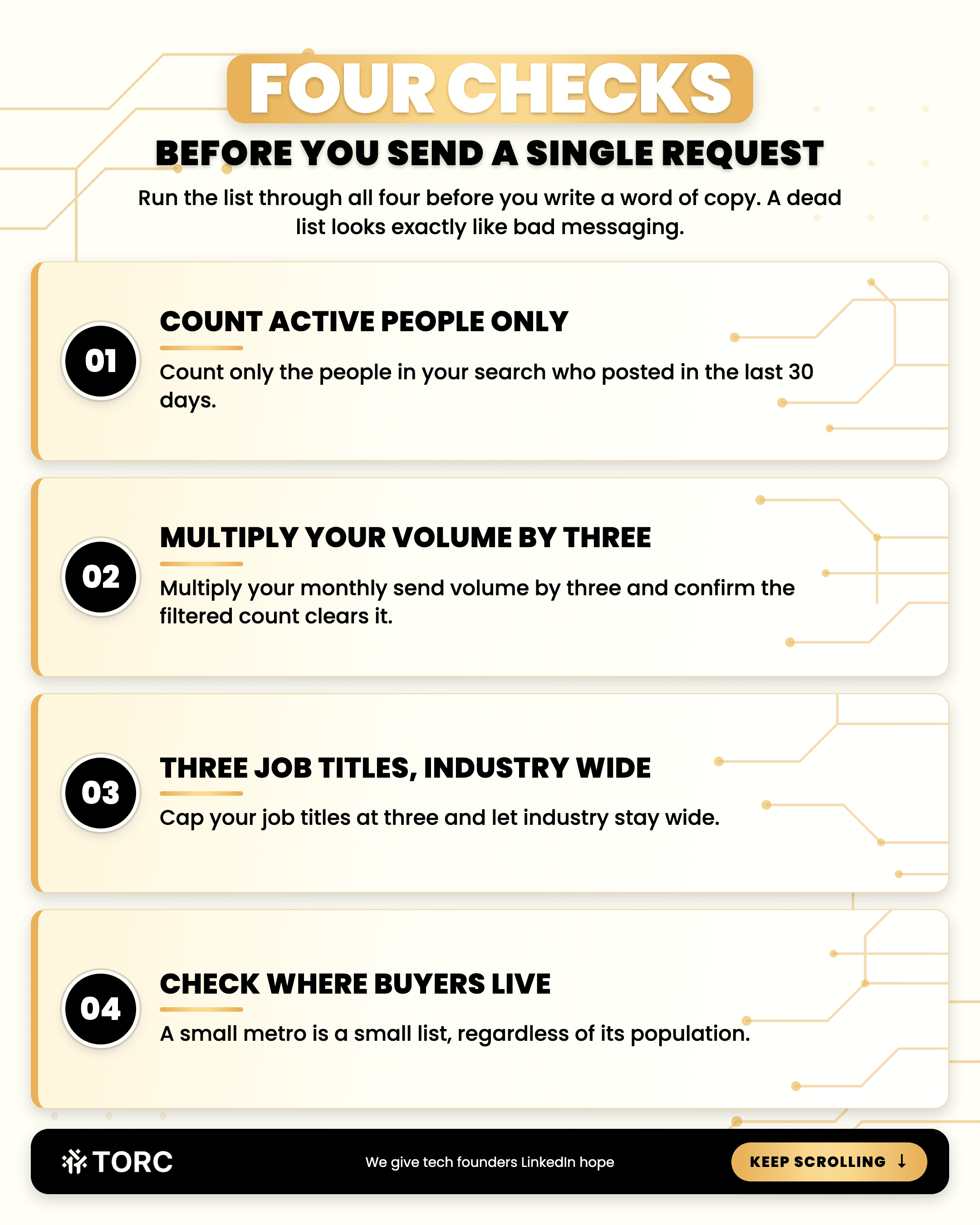
4 checks before you send a single request
Count only the people in your search who posted in the last 30 days. If you start getting desperate, start sifting for the comment-only folks.
Multiply your monthly send volume by 3 and confirm the filtered count clears it
Cap your job titles at 3 and let industry stay wide
Check where your buyers actually live, because a small metro is a small list regardless of its population
Steve Lewis
CEO
TORC Executive Marketing
Want 60 to 80 sales conversations started for you each month, with zero automation?
Frequently asked questions
How big should a tech founder’s LinkedIn target list be for a 90-day campaign?
Around 2,400 active people. The arithmetic is roughly 800 connection requests a month at full account speed, multiplied by the 90 days LinkedIn needs before it produces pipeline. Month one runs lower while the account warms up, which gives you a little margin inside that figure.
Does a bigger target list always produce more conversations?
No. A list padded with people who never post produces sends without replies, and connecting with people who don’t engage drags down the distribution of your content to everyone else. Size the list on active people only. Regularly take precautions to avoid burnout, which will happen.
How do you tell whether someone is active enough to target on LinkedIn?
Check whether they posted in the last 30 days in Sales Navigator. Commenting a couple of times a week also counts, since plenty of buyers read and comment without ever publishing. Anyone with no activity inside a month should come off the list.
What happens when a LinkedIn target list runs out mid-campaign?
Results fall off and it looks like a messaging problem, which sends most tech founders into rewriting copy that was working fine. The tell is strong acceptance numbers early followed by a sharp drop with nothing converting behind it. The fix is widening the industry filter or moving to a larger metro rather than editing the message.
TORC GPT
Still have a LinkedIn™ question? Ask the TORC GPT.
Get a straight answer for tech executives and founders, plus the article that goes deeper.
Popular questions

Tech Executive & Founder Positioning
How to add a featured section on LinkedIn as a tech executive
The 5 steps to a LinkedIn featured section that books calls: A gated lead magnet in slot 1, a gated Contact Me form in slot 2. Built for tech executives.

Content Strategy & Ghostwriting
How do you find the best LinkedIn ghostwriter for a tech CEO?
How tech CEOs and executives pick the best LinkedIn ghostwriter: 3 first-call questions, why to skip the sample post, and how long a fair trial runs.

LinkedIn™ Lead Generation & ROI
WHAT SESAME STREET CAN TEACH YOU ABOUT SALES CALLS
Tech founder, buyer giving you nothing on the sales call? Ask the 5 Ws in order, then make 1 plain ask. The exact questions, plus why they work.