
3-4
mins
What does the data actually show about title and reply rates?
Almost nothing, once the title is standing by itself. Expandi’s own numbers put a VP and an SDR messaging the same audience at roughly the same acceptance rate, and reply rates run flatter still, 9.6% to 11.4% across every seniority band.
A separate analysis of 2,400-plus LinkedIn outreach campaigns landed in the same place, finding sender seniority accounts for only 2% to 3% of the total variance in response rate.
I have a callout to make here though. Expandi is a LinkedIn automation vendor reporting on its own users, and we’re vehemently against automation in any form. Look at how low these numbers are across the board. A 9.6% reply rate is what happens when software sends the message for you.
This is exactly why we are vehemently against any form of automation (On top of the risk you run of getting banned or suspended, which will happen inevitably.)
So why did AT&T executives accept at over 60%?
Because a household name was attached to every request. I ran this myself across AT&T Business executives, all of them VPs or presidents at minimum, and acceptance sat at double what the platform average predicts for a C-level sender.
That difference is the part the aggregate data hides. “C-suite” in a 13-million-request dataset is mostly C-suite at companies nobody has heard of, and a title on an unrecognized logo is a stranger with a job description. Put Intel, AT&T, or Accenture next to the same title and people accept because they want the big shots in their network.
The same effect shows up one rung down. Fellow C-suites at Fortune 500 level, and recognized names inside a narrow niche industry, both pull the way the logo does. Recognition is the asset. This is one of the very few times that relying on your brand’s logo works in your favor when it comes to LinkedIn.
What carries you when the logo doesn’t?
The message, and it carries everything. An EVP and CISO on TORC’s roster ran outreach into CPOs and VPs of Compliance and 63 sales conversations started, 11 organic sales calls, and $365K in ARR in a single month. What produced it was a message a VP of Compliance was willing to answer.
That tracks with something I’ve told clients for years. The more senior your prospect, the more pitch-slapped they already are. Someone fielding 60 cold pitches a week has stopped scanning credentials entirely and is looking for the one message that reads like a person wrote it.
This is the DM I’ve used to open that kind of conversation:
“Hey [NAME], thanks for connecting.
Appreciate you connecting.
Silly question: When you accepted the request, were you just growing the numbers, or did something about my profile make you think it might be worth the connect?
Always love to ask new network folks.
(A real person wrote this message. It’s really me.)”
Nothing in it leans on a title. It leans on a real question about the one thing the recipient just did.
Does a personalized connection note actually help?
Yes, when it’s genuinely personalized. You can run volume outreach with a blank request and it works fine. If you’re sending 20 a day with your own hands, a note lifts your accept rate, and it’s worth the minute.
Personalized means their last post. The moment you open on their job title and their company, an executive knows exactly how much work you did, because both of those are printed on the profile you just clicked. That’s surface-level research and it reads as surface-level research.
Senior people are actively turned off by it. They’ve been mined by enough vendors to recognize the shape instantly, and the note now works against you. AI slop does the same thing with more syllables and gets spotted in 3 words.
Read what they published recently and reference the specific thing they said. That’s the whole bar, and it’s the reason the note works at all.
Shorter is always, always better here. If it feels like work to read, that’s because it is.
Where else does warming up beat the title?
Before you send anything. Expandi found accounts with 1,000-plus followers and consistently engaged posts accept at 30% to 37%, against 27% to 29% platform-wide. That lift comes from a name the recipient already half-recognizes, which is the same mechanic as the AT&T logo working at smaller scale.
This is exactly why we require our clients to have at least 1,000 followers for us to work on their profiles. If they don’t, we’re very upfront about telling them it’s going to take us at least 2 months to get your account in shape before we can start the real work.
If keeping content moving is the part that keeps slipping on a packed calendar, turning your own schedule into raw material fixes that faster than blocking off writing time you don’t have.
The Aurium research adds one more wrinkle. Peer-level messages, a VP writing to a VP, outperform a subordinate-level sender by 3% to 5%. Match beats seniority.
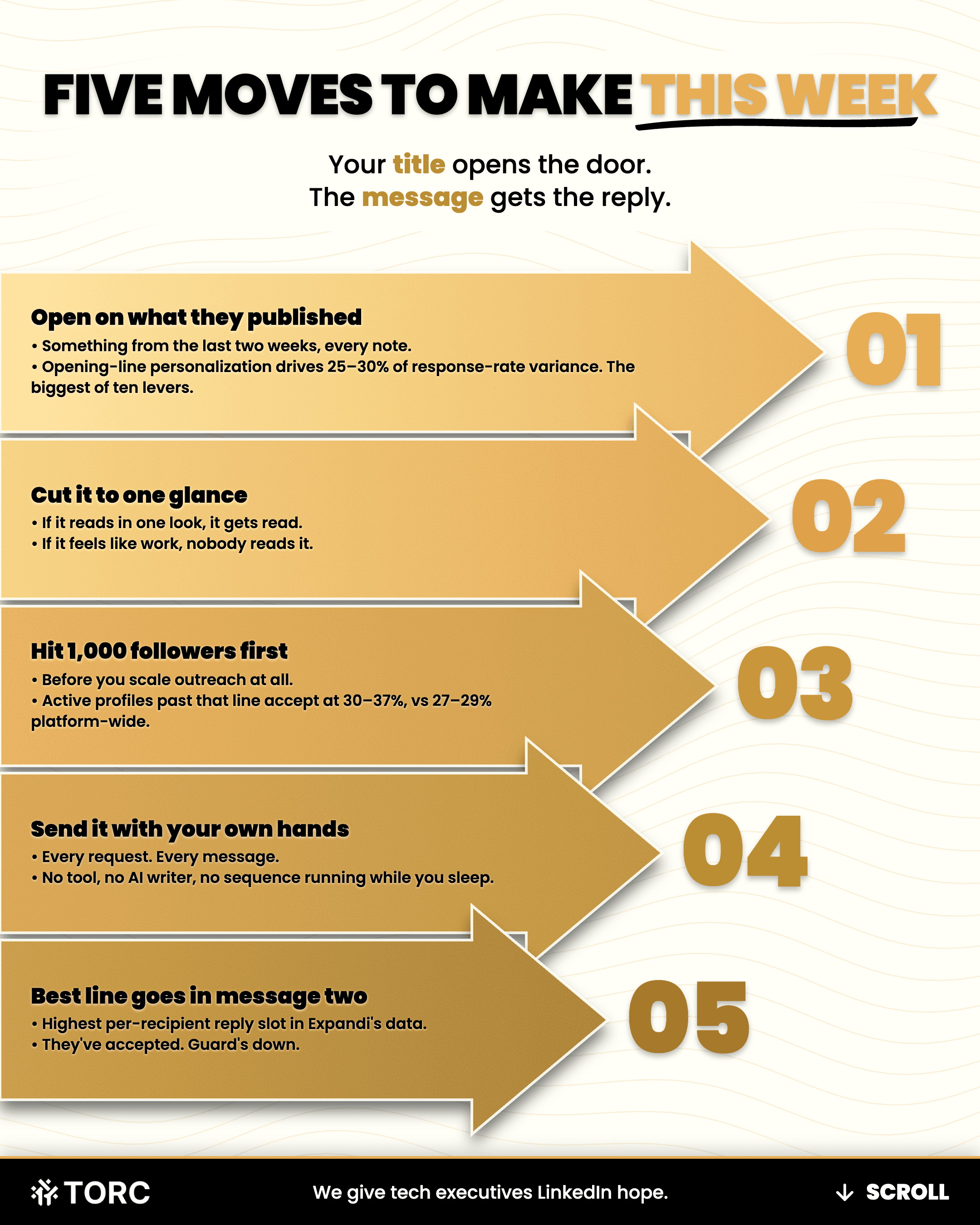
5 Moves To Make This Week
Open every connection note on something they published in the last 2 weeks. Aurium’s ranking of outreach variables puts opening-line personalization at 25% to 30% of the total variance in response rate, the single biggest lever on a list of 10
Cut that note until it reads in one glance. If it feels like work to read, nobody’s reading it
Get past 1,000 followers before you scale outreach at all. Active profiles above that line accept at 30% to 37% against 27% to 29% platform-wide
Send every request and every message with your own hands. No tool, no AI writer, no sequence running while you sleep
Put your strongest line in message 2. It’s the highest per-recipient reply slot in the Expandi data, because the recipient has already accepted and is reading with less guard up
Steve Lewis
CEO
TORC Executive Marketing
Want the message that actually gets the reply?
Frequently asked questions
Does AI-personalized outreach outperform writing the message yourself?
No, and the vendors selling it published the number. Human-written templates beat AI-hyperpersonalized messages by 12% on acceptance in Expandi’s own within-account testing, with reply rate flat between the two. Use AI to get a draft moving if you want, then rewrite it with what you actually know about the person, which you can do by copy and pasting their recent post into Claude, then training it on what to say, and having it saved to that project’s memory.
What do I do if the prospect hasn’t posted anything in months?
Go to their comments. Plenty of senior people never publish and comment constantly, and a comment they left on someone else’s post is the same signal as a post of their own. If there’s nothing at all in either place, send the request with no note and earn the conversation after they accept.
Is there a best time of day to send connection requests?
Morning, by a wide margin. Requests sent between 7 and 11am accept at roughly 32%, against 23% to 24% in the evening. Day of week barely moves either number, so don’t overthink Tuesday versus Thursday.
How many follow-up messages should go out before you drop a lead?
3. Campaigns with 3 messages reply at 9.8%, the best of any length, and 5 or more drops to 5.0%. That’s worse than sending 1, because a long sequence trains the recipient to ignore you.
Does this change if I’m a tech founder rather than an executive?
It flips which lever you have. Most funded startups carry no name recognition at all, so the acceptance lift I saw at AT&T isn’t available to you and won’t be for years. That puts the full weight on your note and on what a prospect finds when they land on your profile after accepting.
TORC GPT
Still have a LinkedIn™ question? Ask the TORC GPT.
Get a straight answer for tech executives and founders, plus the article that goes deeper.
Popular questions

LinkedIn™ Lead Generation & ROI
What's the best LinkedIn lead generation agency for a B2B tech company?
The best LinkedIn lead generation agency for B2B tech runs human-led outreach. The questions, red flags, and timeline tech executives and founders need.
Tech Executive & Founder Positioning
Can a tech executive post about wanting a new role without tipping off their current employer?
Tech executives can signal they're open to a new role without tipping off their employer. See how LinkedIn's recruiters-only setting works.

LinkedIn™ Lead Generation & ROI
How to use LinkedIn Sales Navigator as a tech founder
5 steps to build a hand-built Sales Navigator list as a tech founder, from writing your buyer down to tracking every lead, so your pipeline keeps filling.