
3-4
mins
Yes, and it’s a fix your engineering team already made. Ask every inbound lead the same 6 questions, in the same order, written down before the call starts. 2 of them carry most of the weight: What 1 closed deal is worth to them, and what this going badly in 4 months would look like.
You’d never let your team wing an interview. There’s a question list, a rubric, and somebody on the panel whose job is to say no.
Then a DM lands and all of that goes out the window. You reply in whatever direction the message points, you book the call because they seemed keen, and 6 weeks later you’re 3 calls deep with someone who was never going to buy.
Call it a process if you want. It’s a coin flip with a calendar invite.
What does a hiring loop do that your sales call doesn’t?
It asks the same things every time, which is the only reason the answers mean anything.
Google runs what it calls structured interviewing, where the same set of questions goes to every candidate for the same job rather than questions built off whatever’s on that person’s resume. Their staffing lead described the point as knowing in advance what a good answer sounds like next to a mediocre one.
You can’t judge an answer you’ve never heard twice.
The second thing a hiring loop does is stop. Google’s own data landed on 4 interviews as the point where they hit roughly 86% confidence on a hire, with the fifth barely moving the number.
Now count your own. How many calls have you taken with someone who still hasn’t told you what a deal is worth to them?
Which 6 questions actually do the filtering?
These, in this order, written down before you get on.
What were you hoping to get out of this call today? They’ll tell you in one sentence whether they came to solve something or to browse.
What have you already tried to fix it? Someone who’s tried nothing hasn’t felt the problem yet. Someone who’s tried 3 things will tell you exactly what to avoid pitching.
What’s 1 closed deal worth to you? A buyer closing at $2,000 a deal runs a different business from one closing 6 figures, and your price has to make sense against theirs.
What does it cost you if nothing changes this year? They price the pain in their own words, which beats any number you could hand them.
What does this look like if it goes badly in 4 months? Framing around failure pulls a far more honest answer than asking about goals. People will describe their real fear when they won’t describe their real target.
Who else has to say yes before you can start? The person most likely to kill this is usually the one who thought they could do it in-house.
The whole sequence runs about 5 minutes. It replaces the 3 calls you’d otherwise spend circling the same ground.
Notice none of the 6 are about you. That’s the point of writing them down, because the moment you improvise, you drift back to talking about your product.
Sounds cold. The alternative is taking someone’s money for something that was never going to work for them.
Why is a tech founder the worst person to vet their own inbound?
Because you need the revenue.
Amazon built a mechanism specifically for this. Their Bar Raiser program, started in 1999 by then-CIO Rick Dalzell, drops a trained volunteer from another team into the hiring loop as an objective third party who has no stake in filling the seat.
The hiring manager feels the empty seat every day. The Bar Raiser feels nothing.
You reading an inbound DM are the hiring manager with the empty seat and nobody playing Bar Raiser. The questions have to carry the load your judgment can’t.
4 answers I’d treat as a no:
“We’ve got time to figure this out.” Urgency is the buying signal. A wide-open runway means the pain isn’t expensive yet.
“Can we start with one month and see?” That hesitation usually traces back to their own systems.
“My cousin said you were great.” A referral is a better lead on average, and that’s exactly what makes it easy to accept against your own judgment. Same 6 questions.
“If this works, it fixes everything.” Anyone leaning on 1 channel to solve the whole business will fixate on every small thing that isn’t perfect.
Why does the buyer already know all this?
Because they researched you before they typed a word, and you can’t see any of it.
Gartner surveyed 646 B2B buyers and found 69% turn to a rep specifically to validate what AI already told them, after working through an average of 7 information sources on their own. 45% used generative AI during a recent purchase, mostly to research vendors and products.
They booked you to pressure-test a conclusion they’ve already reached.
The number sitting underneath that one is the one I’d tape to your monitor. In the same survey, 51% said they’re more likely to run into misleading information from generative AI. 49% said the same about a sales rep.
You’re rated a coin flip against a chatbot. The only way to beat that is being the person who asks sharper questions than the machine did.
Which is exactly where the hiring comparison earns its keep, and then breaks in 1 specific place. A candidate applied for the job. Your inbound lead didn’t, and the more senior they are, the more they’ve been pitch-slapped this week.
You get 1 call where a hiring loop gets 4. That 1-call cap is my own rule, with no study behind it, and it exists because the scarce thing now is your buyer’s patience.
Worth remembering they’re running their version of this on you at the same time. Your profile does that work before you open your mouth, which is the same reason profile views move before your calendar does.
You built the say-no role once already, for hiring. Build it again for revenue.
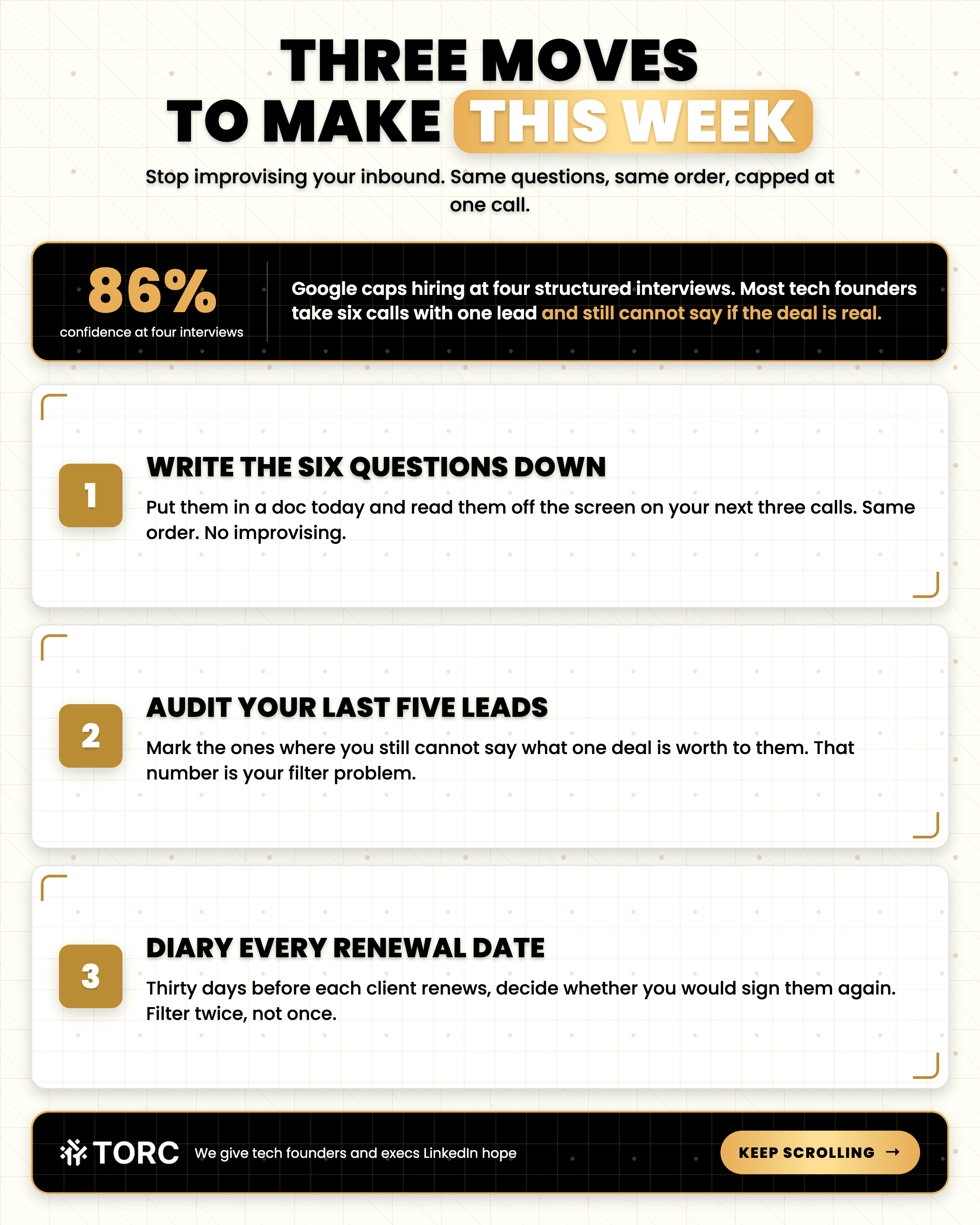
3 moves to make this week
Write the 6 questions in a doc today and read them off the screen on your next 3 calls, in the same order, with no improvising.
Pull up your last 5 inbound conversations and mark the ones where you still can’t say what 1 deal is worth to that person. That count is your filter problem, expressed as a number.
Put the 2 hardest questions, cost of inaction and who else has to say yes, in the first 10 minutes. They decide everything and they get skipped when the call runs long.
Steve Lewis
CEO
TORC Executive Marketing
Ready to build the rest of your filter?
Frequently asked questions
Should you send the questions to the lead before the call?
No. Send an agenda if you want, and keep the questions in your own notes. A prospect who sees “what’s one closed deal worth to you” in an email has time to build an answer that gets them what they want, and the unrehearsed version is the one worth hearing.
What do you do when a lead won’t answer the money question?
Ask it a second way before you move on. “Rough range is fine” or “what does a typical contract look like for you” gets past the reflex most of the time. If they still won’t answer on a first call, that’s the answer, and it usually means you’re talking to somebody who can’t sign.
Can you qualify a lead in the DMs instead of booking a call?
2 of the 6 work fine in a DM, usually what they were hoping to get out of a conversation and what they’ve already tried. The rest need tone of voice, because you learn as much from the pause before the answer as from the answer. Use the DM to decide whether the call happens at all.
What if the lead qualifies but the timing is wrong?
Say so, put a date on it, and stop selling. A buyer who tells you their budget cycle opens in January is giving you a real answer, and pushing anyway is how you turn a future client into someone who stops replying. Log it, follow up the week before the cycle opens, and spend this quarter on somebody who can start.
TORC GPT
Still have a LinkedIn™ question? Ask the TORC GPT.
Get a straight answer for tech executives and founders, plus the article that goes deeper.
Popular questions

LinkedIn™ Lead Generation & ROI
WHAT SESAME STREET CAN TEACH YOU ABOUT SALES CALLS
Tech founder, buyer giving you nothing on the sales call? Ask the 5 Ws in order, then make 1 plain ask. The exact questions, plus why they work.

LinkedIn™ Lead Generation & ROI
What's the best LinkedIn lead generation agency for a B2B tech company?
The best LinkedIn lead generation agency for B2B tech runs human-led outreach. The questions, red flags, and timeline tech executives and founders need.
Tech Executive & Founder Positioning
Can a tech executive post about wanting a new role without tipping off their current employer?
Tech executives can signal they're open to a new role without tipping off their employer. See how LinkedIn's recruiters-only setting works.