
3-4
mins
Yes, and the shift happened at the vendor level. Through 2026 LinkedIn removed the company pages and executive profiles of the automation tools themselves, and they aren’t stopping there. Your own account risk works the way it always has. LinkedIn reads your sending pattern, so a tech founder doing it by hand at high volume trips the same wire.
There’s no notice. You’re lucky if you get a warning. There’s no customer service to complain to. Your profile is just gone. Forever.
Did the rules change, or did the enforcement?
The rules didn’t change. LinkedIn’s User Agreement has barred bots, crawlers, browser plugins, and automated messaging under Section 8.2 for years.
What changed is who LinkedIn went after., and they turned the dial up. WAY up.
In January 2025, LinkedIn sued the B2B data company Proxycurl and its founders in the Northern District of California. The complaint carried 6 separate claims, including breach of contract, CFAA, fraud, and misappropriation, and asked the court to order destruction of any data inferred, aggregated, or synthesized from what had been extracted.
The case settled. Afterward, the founder, Steven Goh, wrote the whole thing up publicly, and his conclusion fit in 4 words: “Legal does not mean safe.”
He keeps no LinkedIn account now. No profile, no company page, nothing.
Then it reached the outreach tools. On March 25, 2026 LinkedIn removed HeyReach’s company page, roughly 16,400 followers, and restricted the personal profiles of its CEO, CTO, CRO, and CMO. No notice and no communication.
HeyReach published their own account of it in August. 2 lines in that post carry more weight than any competitor’s analysis of the same event.
The first is a sentence most vendors would never put in writing. There’s “no approved outreach automation tool,” theirs included.
The second is that they expected it. Losing the page was a question of when rather than if.
Read that again as a tech founder evaluating tools. The people who build these products budget for losing their own presence on the platform they automate.
Sadly, our beloved commenting tool, Extrovert fell to the same fate. Founders profiles… gone. Company profile, same. We used Extrovert to help source comments by topic and sales navigator lists. Let’s face it, searching for posts through sales navigator or native LinkedIn keyword search is a pretty dreadful experience unless you’re specifically looking for terrible posts from third-world countries, which, let’s be real, you aren’t.
Extrovert is one of the safest tools because they do follow LinkedIn’s very strict API rules. Didn’t matter. It’s technically an outreach tool. Ultimately, they created it because sales navigator is just so awful. It is a truly amazing tool and if there is a “safe” tool, this would be it. They still have yet to get any users banned by LinkedIn as of the date of this blog.
Why does manual outreach get punished the same way?
Vendor enforcement makes the headlines. Account throttling is what actually costs a tech founder pipeline, and it runs on completely different inputs.
4 separate client accounts for HeyReach reportedly had gone from 20 to 40 engagements per post down to near zero inside 6 weeks. None of them was running an automation tool.
Every one of them had been sending high volumes of connection requests to people who never engaged with their content. The platform read a consistent daily send volume as automation and throttled accordingly.
HeyReach says the same thing in their post, which is worth noticing given what they sell. Restrictions land on accounts running automation and on accounts sending everything manually.
Pace is a separate signal from volume. 40 requests inside 10 minutes reads very differently than 40 spread across a working day. 6 messages in 3 minutes looks machine sent even when a human typed all 6.
The damage also doesn’t reverse on request. One of our clients started with us around 27k followers, account arrived with 27,000 followers and 10 to 30 likes per post after years on an automation tool called Dripify. He had awful engagement proportionate to his following, and Dripify was absolutely to blame.
We did 3 months of remediation work, well past what the contract covered. There was no chance of bringing distro back. The follower count was “real” and the reach was dead.
You can identify these accounts on sight once you know the shape. High follower count, almost Next to no engagement. If your own limit has already dropped, the mechanics behind that sit in what actually decides your connection request limit now.
What does this actually mean for a tech founder’s account?
An executive who loses their LinkedIn account loses a channel. A tech founder loses the company’s main entry point.
That asymmetry is the entire calculation. Your profile is where an investor lands before agreeing to a first meeting and where an enterprise buyer checks you mid-cycle.
The rule scales inversely. The more your account is worth, the less tool risk you can justify carrying, naturally.
The counterargument always arrives in the same shape. Someone points at an account that has run automation for 3 years without a scratch. “I’ve gotten away with it this long. They won’t get me if they haven’t by now.” Downright arrogance.
That’s only evidence that enforcement is inconsistent and delayed. Everyone credible in this category already knows that part. No legitimate LinkedIn expert would do it. Damn sure none of the “Buy my Claude outreach” so-called gurus would either.
There’s a version of outreach that runs entirely on human sending at a pace a person can sustain, which is how we structure LinkedIn lead generation for tech executives and founders on every account we touch.
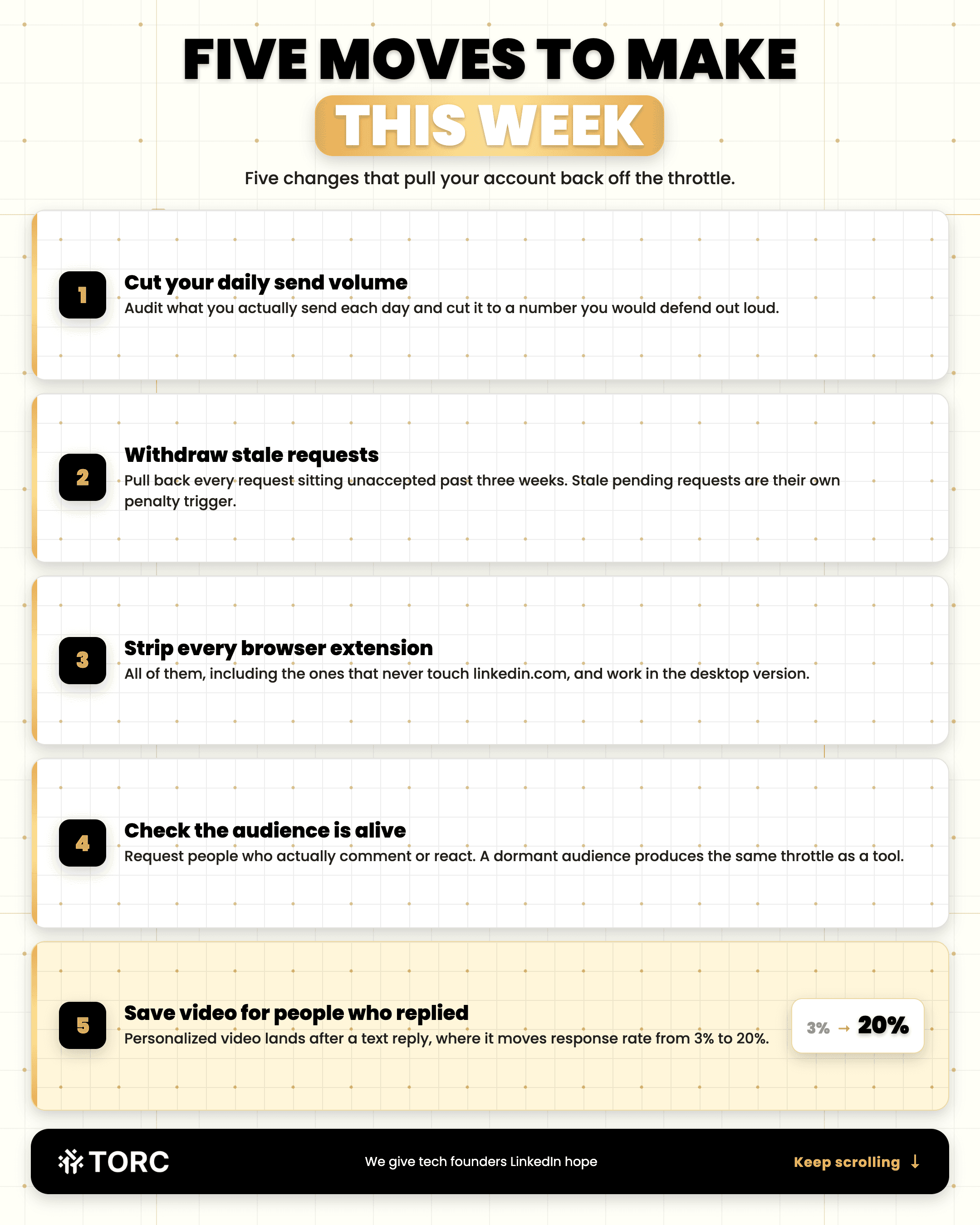
5 moves to make this week
Audit your real daily send volume and cut it to a number you would defend out loud
Withdraw every connection request still sitting unaccepted past 3 weeks, since stale pending requests are their own penalty trigger
Strip your browser of extensions entirely, including the ones that never touch linkedin.com, and work in the desktop version
Check that the people you are requesting actually comment or react on LinkedIn, since a dormant audience produces the same throttle as a tool
Save the personalized video for people who have already replied in text, where it moves response rate from 3% to 20%
Steve Lewis
CEO
TORC Executive Marketing
Want the human version of executive and founder personal branding and lead generation?
Frequently asked questions
Did LinkedIn change its automation rules in 2026?
No. LinkedIn’s User Agreement has prohibited bots, crawlers, browser plugins, and automated messaging under Section 8.2 for years. What changed in 2026 is enforcement reaching the vendors themselves, including the removal of an automation company’s page and the restriction of 4 of its executives’ personal profiles in March.
Will my LinkedIn account get banned if I use an automation tool?
The outcome is unpredictable, which is the actual problem. Sometimes it is a warning and sometimes the account is removed permanently, with no appeal process and no path to recovery. An account that has run a tool for years without consequence only demonstrates that enforcement is delayed, and the downside stays total either way.
Is manual outreach actually safer than automation?
Only if the pattern changes with it. 4 separate accounts lost nearly all engagement inside 6 weeks while using no automation tool at all, purely from high send volume aimed at people who never engaged with their content. LinkedIn scores volume, pace, and audience fit, so manual sending at automation-like volume produces the same result.
Can a throttled or damaged LinkedIn account recover?
Often it can’t. An account with 27,000 followers and 10 to 30 likes per post couldn’t be restored after 3 months of active remediation work. 3 months of extra engagement work beyond the contract couldn’t bring the distribution back, which is why the account is worth protecting before anything goes wrong.
How many connection requests should a tech founder send?
Start around 100 a week on a dormant or new account and build toward full speed across 3 to 4 weeks. Ramping from a quiet account to hundreds of requests overnight is the exact step change that gets flagged. Pace matters as much as the total, so spread sends across the day and withdraw anything still pending after 3 weeks.
TORC GPT
Still have a LinkedIn™ question? Ask the TORC GPT.
Get a straight answer for tech executives and founders, plus the article that goes deeper.
Popular questions

Content Strategy & Ghostwriting
How do you find the best LinkedIn ghostwriter for a tech CEO?
How tech CEOs and executives pick the best LinkedIn ghostwriter: 3 first-call questions, why to skip the sample post, and how long a fair trial runs.

LinkedIn™ Lead Generation & ROI
WHAT SESAME STREET CAN TEACH YOU ABOUT SALES CALLS
Tech founder, buyer giving you nothing on the sales call? Ask the 5 Ws in order, then make 1 plain ask. The exact questions, plus why they work.

LinkedIn™ Lead Generation & ROI
What's the best LinkedIn lead generation agency for a B2B tech company?
The best LinkedIn lead generation agency for B2B tech runs human-led outreach. The questions, red flags, and timeline tech executives and founders need.