
3-4
mins
Point the expertise at their problem instead of at yourself. “I’ve shipped this 11 times” is a résumé line, and “if you haven’t shipped this before, here’s the part that breaks” is the same expertise doing work for the reader. Nothing about your authority changed.
Why does your expertise post read as arrogant when the expertise is real?
Because of the first line.
I mark up a lot of drafts, and the same note goes on more of them than any other note I write. The post runs long. It has em dashes in it. The opening talks about the author instead of the problem the reader woke up with.
The third one is the only one that really costs you performance.
What happens next, every time: The tech founder subconsciously feels the arrogance coming and reaches for a softener.
“I’m no expert, but.”
“Probably obvious to most of you, but.”
“Not sure why people keep asking me this.”
That instinct is pulling the wrong lever. Researchers at Harvard Business School and UNC ran a field experiment where someone approached 113 people in coffee shops and either stated an accomplishment plainly or wrapped the same accomplishment in a complaint before asking for a petition signature. 85.7% signed after the plain version and 64.9% signed after the wrapped one.
The setting was a coffee shop, but the finding underneath transfers to LinkedIn™: People register the self-promotion either way, and the softening stacks insincerity on top of it.
Which leaves you a third option that almost nobody uses.
What does the same expertise look like pointed at the reader?
Turn the claim about you into a warning for them.
Before: “I’ve spent 15 years building payments infrastructure.”
After: “If you haven’t built payments infrastructure before, you’ll underestimate reconciliation, and it’ll cost you a quarter.”
The credential is still sitting underneath. The reader just gets a problem they recognize rather than a bio they are supposed to be impressed by. Success is quite literally measured in milliseconds on LinkedIn, be it your message, your headline, banner photo message, about section, etc.
This is the same move as the headline rewrite I give every tech founder who asks me to look at their profile.
Before: “AI Transformation for Series B founders and corporations | 3 Exits
Ex-Google | Proud Dad”
After: “I help CISOs save $10M during M&A with AI.”
8 words. No credentials. It works because it names somebody else’s pain.
This is what the buyers themselves say they want. The 2025 Edelman-LinkedIn B2B Thought Leadership Impact Report, now in its 7th year, drew on nearly 2,000 global professionals including the hidden decision-makers who kill or accelerate a deal.
It found those buyers reward thinking that informs or challenges their perspective, and that bold, perspective-shifting ideas are what earn their attention.
Nobody in that study said they wanted a summary of your background. So, quit patting yourself on the back. We know you don’t mean to, but you have to be hyper conscious of it. Nobody does it on purpose.
This is also the exact place an AI draft will sell you out, because a model’s default opening is a paragraph about the author. I went through what AI should and shouldn’t be doing to a tech founder’s LinkedIn posts separately.
What about the former colleagues who will see it?
They’ll see it. Some of them will have opinions.
I got laid off from 2 Fortune 500 social media programs in back-to-back years. I helped both, Intel and Accenture, hit their engagement targets. Like most corporate social programs now (or AI initiatives), if you can’t translate the business value, it’s near-useless.
A tech founder who stays quiet to avoid looking arrogant is carrying that same risk in a different building. Your former colleagues aren’t in your buying group. Stop worrying about what they think… entirely.
The people who are will read you carefully and never once tell you they did, the same way investors already work through a founder’s profile before agreeing to a first meeting.
You are choosing between one audience that might think you are showing off and another audience that decides whether you get the call. Pick.
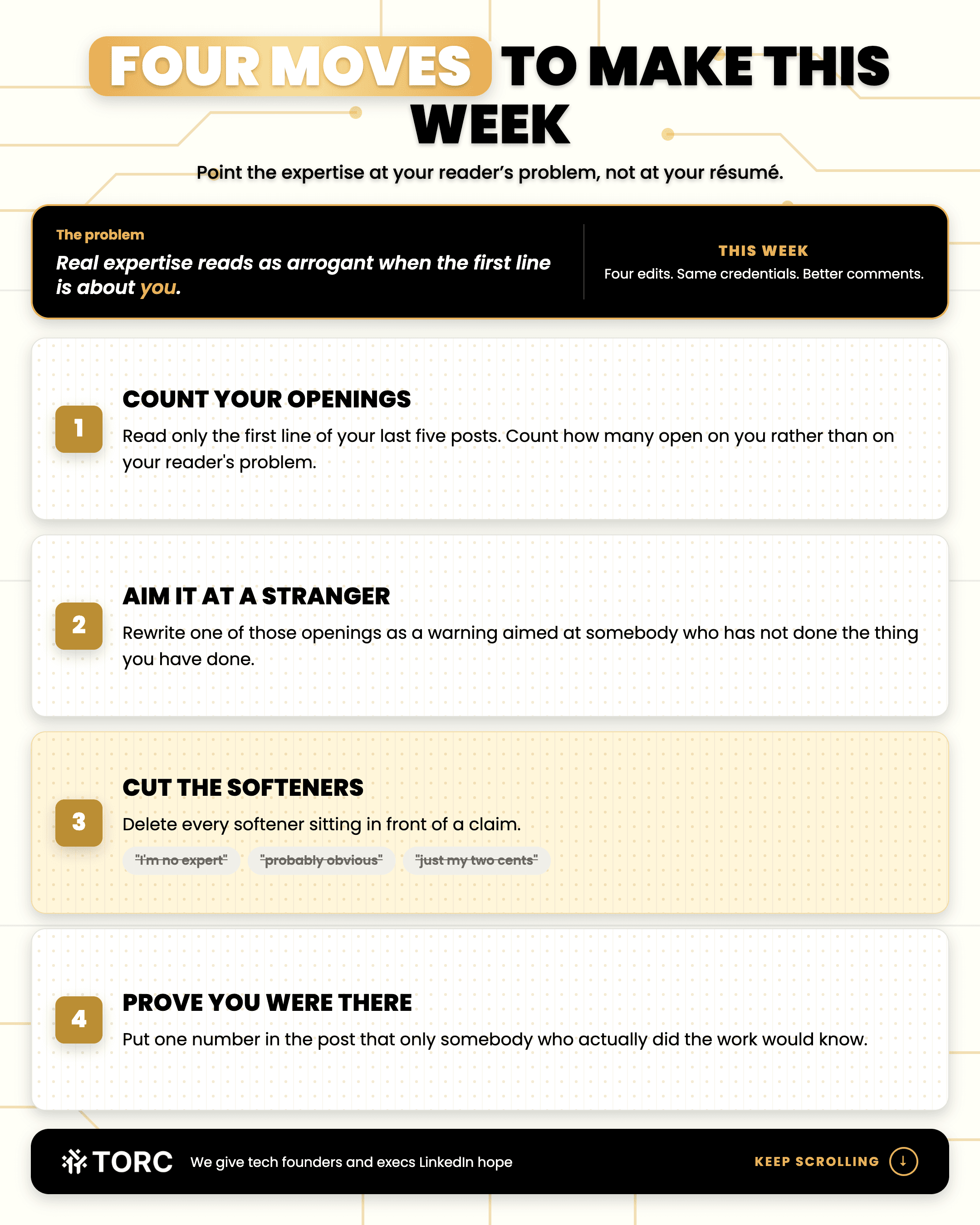
4 moves to make this week
Read only the first line of your last 5 posts and count how many open on you instead of your reader’s problem
Rewrite 1 of those openings as a warning aimed at somebody who hasn’t done the thing you’ve done
Delete every softener sitting in front of a claim: “I’m no expert,” “probably obvious,” “just my two cents”
Put one number in the post that only somebody who actually did the work would know
Steve Lewis
CEO
TORC Executive Marketing
Want 60 to 80 sales conversations started for you each month, with zero automation?
Frequently asked questions
Is it better to brag plainly than to soften it?
Between those 2, plain wins. A Harvard Business School and UNC study of self-presentation found that wrapping an accomplishment in a complaint or in false modesty lowered both liking and perceived competence compared with stating it straight, because the wrapping reads as insincere. The stronger option is neither one. Point the expertise at a problem your reader currently has, and there’s nothing left to soften.
What if my company is pre-revenue and I have no results to point to yet?
Expertise and results are different things. You know which part of the problem breaks first, which vendor claim is oversold, and which decision founders at your stage get wrong. Write that. A specific, honest, slightly contrarian take separates you far faster than a rosy summary of a product nobody has bought yet.
Will former colleagues judge a tech founder for posting about their own expertise?
Some of them will, and they’re outside your audience. You get 1 core audience with which you can be effective, regardless of your goal. That’s it. Your buyers, your investors, and your future hires read the same posts and reach a completely different conclusion. The cost of staying invisible to the second group is a real number. The cost of mild eye-rolling from the first group is zero.
Where does a tech founder find expertise worth posting about?
Your last sales call. The questions your ideal buyer asked out loud on that call are the questions the rest of that market is typing into Google and ChatGPT this week. A single 30-minute sales conversation holds roughly 30 distinct post concepts, and most tech founders delete the recording and then sit down to invent topics from nothing.
TORC GPT
Still have a LinkedIn™ question? Ask the TORC GPT.
Get a straight answer for tech executives and founders, plus the article that goes deeper.
Popular questions

LinkedIn™ Lead Generation & ROI
WHAT SESAME STREET CAN TEACH YOU ABOUT SALES CALLS
Tech founder, buyer giving you nothing on the sales call? Ask the 5 Ws in order, then make 1 plain ask. The exact questions, plus why they work.

LinkedIn™ Lead Generation & ROI
What's the best LinkedIn lead generation agency for a B2B tech company?
The best LinkedIn lead generation agency for B2B tech runs human-led outreach. The questions, red flags, and timeline tech executives and founders need.
Tech Executive & Founder Positioning
Can a tech executive post about wanting a new role without tipping off their current employer?
Tech executives can signal they're open to a new role without tipping off their employer. See how LinkedIn's recruiters-only setting works.