
3-4
mins
A tech executive who can’t find time to write has a sourcing problem. The fix is recording or dictating answers you’re already giving in meetings, then building the post from that instead of a blank page. Executives still posting a year from now are the ones who stopped trying to compose from scratch.
This makes for better engagement because you’re being calculated about it, talking about the things your target audience wants to know more about instead of whatever is top of mind for you. These things happen more in the wild (at your job) than you realize, by a lot.
Cross-reference what they’re asking about on Reddit and other credible internet sources, and Presto! You have your content. Once you have your system down, it should take you 7 to 8 minutes, max, to write a very high-quality post geared 100% at your target audience.
Once you have your system down with both, recording/sourcing and AI, it should take you a max of 20 minutes per content piece. That includes other platforms, a blog, and assets. (I had Claude draft the blog, edit, then draft the posts for LinkedIn, Facebook, X and Reddit, each specific to its platform, in about 17.5 minutes. Scheduling took me 3 minutes total.)
Why does “I don’t have time” usually mean something else?
Because the real cost is generating an idea from nothing, which is the one thing a fragmented calendar makes almost impossible. You’ll burn out and you’ll put out mediocre content at best if you try to reinvent the wheel every Friday or whenever you have time. That’s an absolute guarantee spoken from personal experience.
Most tech executives actually have plenty of small windows. A 12-minute gap before the next call, a commute, the 10 minutes after a board update wraps. What’s missing is 45 uninterrupted minutes to sit down and invent a topic, and that block flat out doesn’t exist at VP level and above… or Director-level for that matter.
We’ve had executive clients where the only slot that would hold still for a content interview looked nothing like a normal workday. Once, literally at 2am, because that was the only hour their calendar didn’t touch. The fix was shrinking the extraction to fit whatever window actually existed. In this case, creating a window
(Editor’s caution: 2am is unsustainable and was very much a one-time thing.)
Nobody has a spare hour to sit and “write a LinkedIn post.” Anyone selling you that hour is selling you a fantasy you’ll abandon by week 3.
What should replace the blank composer?
Capture beats composition. You already say the thing out loud, usually more than once. The job is catching it. You don’t need to write a novel every single post. You need for it to convey value to your audience. This is what’s referred to as a type of lead magnet. You, your knowledge, a teaser for more to come. That’s when you have them hooked.
When you’re editing, speak your elaborations in posts instead of typing them. You talk differently than you write, and the spoken version is where your real voice actually lives, far more than the version that comes out when you’re staring at a cursor. This is absolutely your biggest opportunity to separate yourself from AI LinkedIn slop. The moment you finish explaining something for the second time this month, that’s the post, and you already road-tested it on a live audience.
This is exactly how a genuinely overloaded EVP and CISO built a $365K pipeline in a single month: Real client conversations turned into content, with no writing habit bolted onto an already full calendar.
How much of your own time does this actually take each week?
Once you switch to capture instead of composition, closer to 15 to 20 minutes. The heavy lift, our personal brand interview that maps out your pillars, is a one-time 2 to 3 hour investment up front, then roughly an hour a month after that to for content interviews, whether we are guiding you over Zoom or you’re doing it yourself.
Edit toward your own cadence. If you clip your sentences short in meetings, the post should too. Fair warning: When you’re first starting out with all AI tools (whether that’s Claude, ChatGPT, Magic Post, Stanley AI, or others), they tend to overwrite the sentences. They are always very run-on.
You have to make your sentences short and punchy. As a rough rule of thumb, every LinkedIn post should have no more than 2 lines per paragraph and no more than 3 sentences max
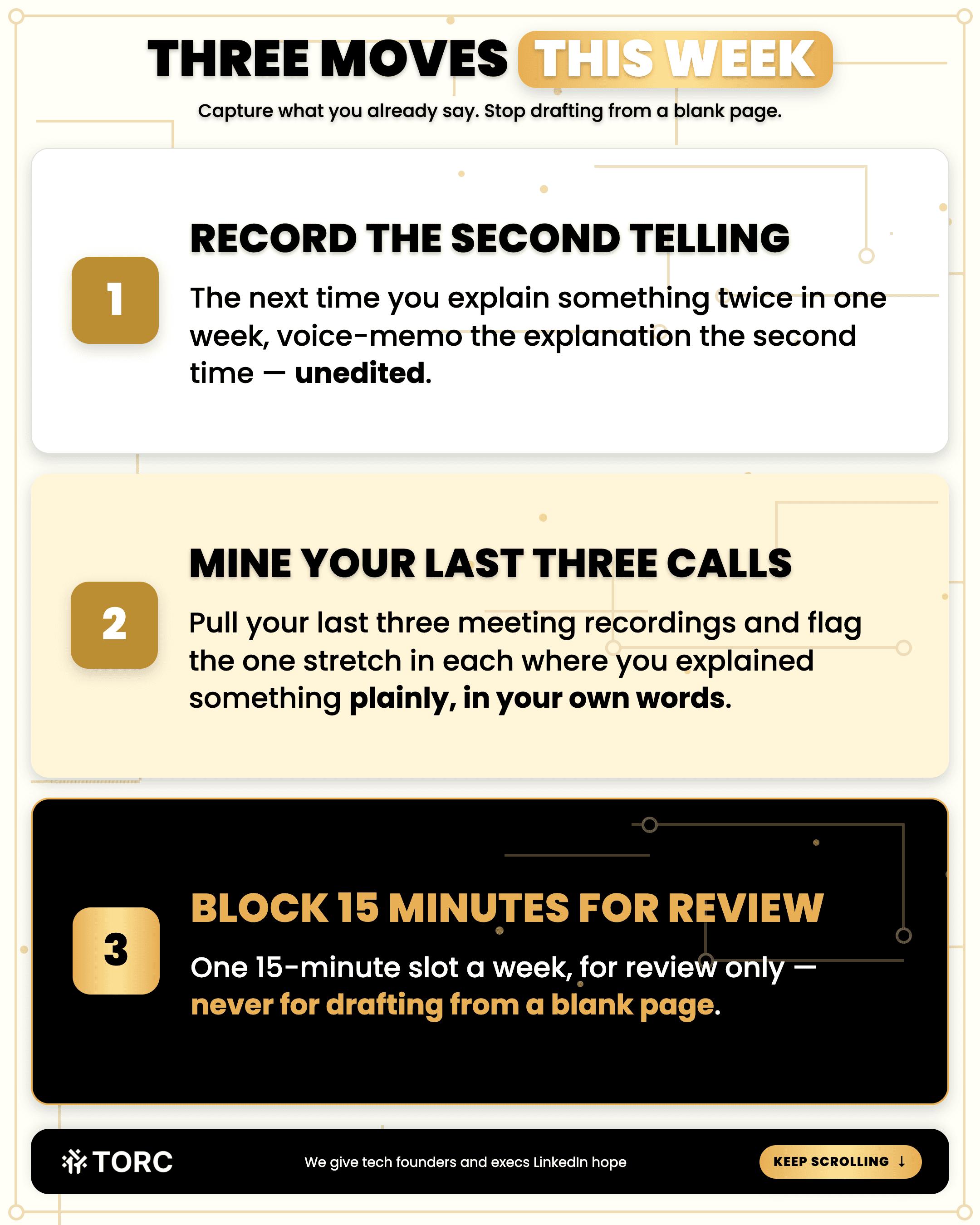
3 moves this week:
The next time you explain something twice in 1 week, voice-memo the explanation the second time, unedited
Pull your last 3 meeting recordings and flag the stretch in each where you explained something plainly, in your own words
Block one 15-minute slot a week for review only, never for drafting from a blank page
Steve Lewis
CEO
TORC Executive Marketing
Ready to be the executive search committees already know?
Frequently asked questions
What if I don’t have client or sales calls to pull material from yet?
Pull from internal meetings instead. A staff briefing where you explained a decision, a board update, even a hallway conversation you’ve now had 3 times, all count. The test is whether you’ve already said it out loud and watched someone react to it.
How do I stop this from sounding like a ghostwriter instead of me?
Match your own sentence length and your own sign-off rather than a generic house style. If you say “look” before a hard point out loud, keep it on the page. The moment a post reads smoother than you actually talk, it’s stopped sounding like you.
Can my employer restrict what I post if the material comes from my own meetings?
Check your company’s social media policy before pulling from anything work-specific, since deal terms and client names never belong in a post regardless of where they came from. Strip identifying detail the same way you would sharing a lesson outside the building, and keep the post to the mechanic rather than the meeting itself.
TORC GPT
Still have a LinkedIn™ question? Ask the TORC GPT.
Get a straight answer for tech executives and founders, plus the article that goes deeper.
Popular questions

LinkedIn™ Lead Generation & ROI
WHAT SESAME STREET CAN TEACH YOU ABOUT SALES CALLS
Tech founder, buyer giving you nothing on the sales call? Ask the 5 Ws in order, then make 1 plain ask. The exact questions, plus why they work.

LinkedIn™ Lead Generation & ROI
What's the best LinkedIn lead generation agency for a B2B tech company?
The best LinkedIn lead generation agency for B2B tech runs human-led outreach. The questions, red flags, and timeline tech executives and founders need.
Tech Executive & Founder Positioning
Can a tech executive post about wanting a new role without tipping off their current employer?
Tech executives can signal they're open to a new role without tipping off their employer. See how LinkedIn's recruiters-only setting works.