
3-4
mins
Does LinkedIn’s AI search actually understand your title?
Sometimes, and only if the recruiter reaches for it. LinkedIn’s AI-Assisted Search is a plain-English layer built to understand conceptual relationships between roles and skills, the kind of tool that surfaces a Python developer from a query about Django because the model knows the 2 are related. It cut real search time from roughly 15 minutes down to about 30 seconds for the recruiters who use it.
That’s a genuine upgrade. It also runs in a different box than the one most executive searches actually start in.
The title filter inside LinkedIn Recruiter, the field a recruiter reaches for on a senior search, works on a stricter rule. LinkedIn’s own help documentation confirms Boolean logic doesn’t work inside the Job Title filter at all, only in the general keyword field. No OR groups, no synonym handling, no AI layer. Type a title into that box and you get a literal match against whatever is sitting in your Experience section.
Why do recruiters still search by literal job title?
Because it’s still the fastest way to size a pool. One headhunter, describing his own routine, opens LinkedIn Recruiter every week and searches for executives the same way: A job title, an industry, a region, a few keywords. The system returns 2,000 to 3,000 profiles. Most shortlists form from the first 40 to 60.
Everyone past that gets skipped, however qualified. If your headline carries no standard title at all, his read is blunt: Zero matches, before a human ever reads your name.
That’s a real gap in how the platform is built. It’s no reason to panic, though. It also means the fix sits entirely inside your own profile rather than in something LinkedIn has to ship. The AI reads your profile eventually. The Title filter reads it first. If this wasn’t the case, Fortune 500 companies like Accenture that use the title “Lead” at multiple levels (including executive) would never get search hits
What do you actually do about your title?
It’s different from what you’d think. Stuffing your headline with your full title and every credential attached to it is the wrong move. (Dear God, please don’t do this. No better way to increase your bounce rate). We have a firm rule here: Lead with who you help and how, since a title-heavy headline reads as patting yourself on the back rather than saying anything a stranger can use.
What changes is where the literal title actually needs to live. Your Experience section’s job title field is the one a recruiter’s Title filter reads word for word, so it needs the standard, spelled-out version instead of a rebrand you invented to sound sharper. “VP Sales” and “Vice President of Sales” aren’t guaranteed to match each other in that field, so cover both if either one is genuinely accurate.
Your Skills section does similar work for the AI layer. It’s built to expand a query into related terms and infer skills from your profile text, so a thin or generic skills list gives that model less with which to work.
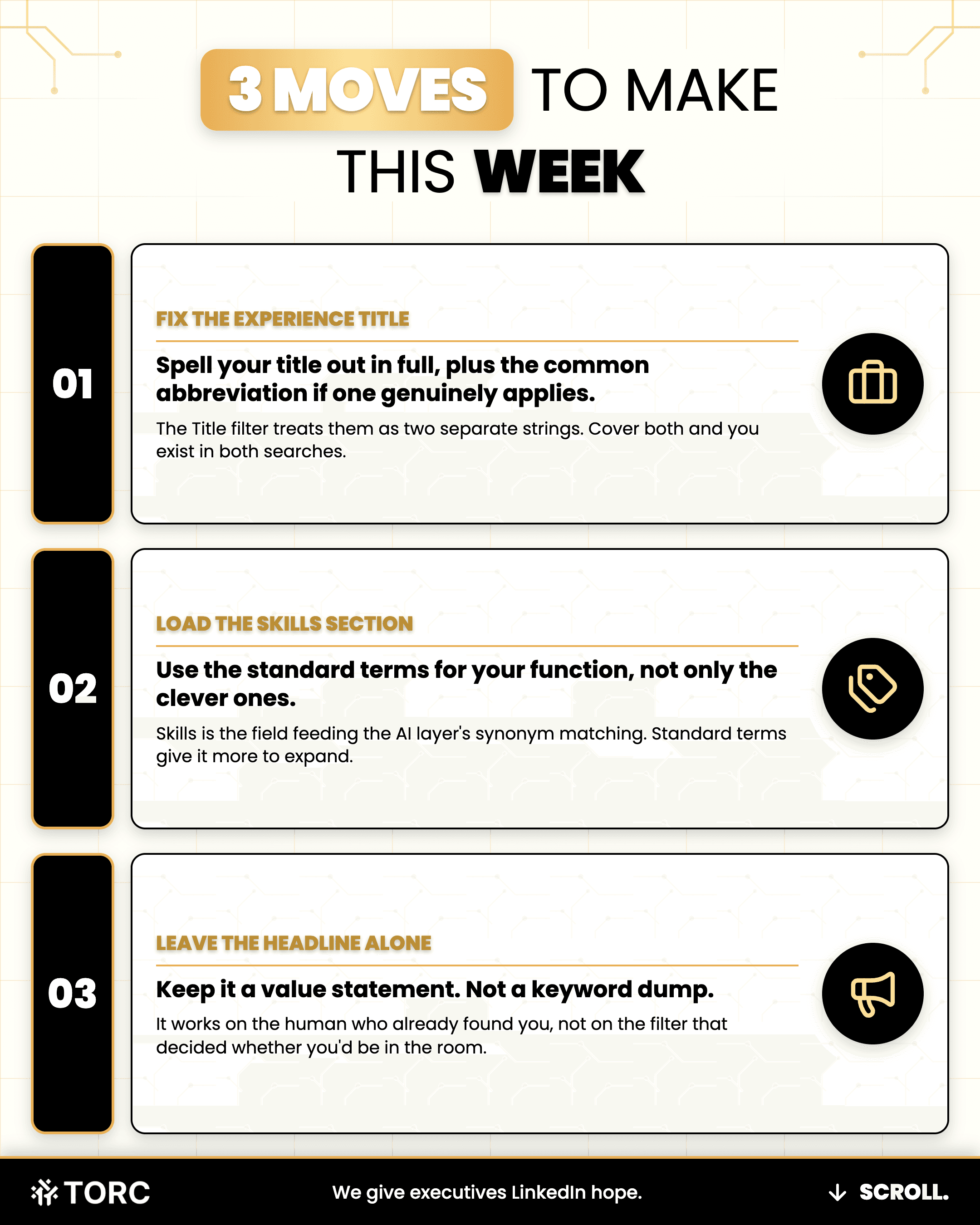
3 moves to make this week
Spell out your title in full inside your Experience entry, plus the common abbreviation if one genuinely applies, since the Title filter treats them as separate strings
Load your Skills section with the standard terms for your function rather than only the clever ones, since that’s the field feeding the AI layer’s synonym matching
Leave your headline alone as a value statement. It does its job on the human who already found you, after the filter has decided whether you show up
This is the same mechanic behind a tech executive landing a $1.5M offer in 4 weeks without applying to a single job, through positioning built for exactly this kind of inbound search. The headline sold the story. The structured fields underneath it were what actually got him found.
Steve Lewis
CEO
TORC Executive Marketing
Curious if your current title is even searchable yet?
Frequently asked questions
Does putting my full title in my headline actually help me get found?
Very little beyond what your Experience field already provides. The headline shows up in the search snippet a recruiter sees after the match happens, but the underlying filter runs off the structured title field instead of the headline text. Keep the full title accurate in Experience and let the headline do the persuading instead.
One of the biggest wastes of your profile you can make is putting repeat information throughout your profile. The horse is dead. Stop beating it.
What if my actual title is nonstandard, like “Head of Everything” or something I invented?
Add the closest standard equivalent somewhere searchable, either as a second line in that Experience entry or worked into your About section. A fully custom title has nothing to match against in a literal filter, so you’re relying entirely on the AI layer picking it up from context, which is a bigger bet than it needs to be.
Does this work the same way on a company’s own careers site search as it does on LinkedIn Recruiter?
No, and that’s worth knowing before you assume one fix covers everything. Most ATS and careers-page search tools run closer to LinkedIn’s Title filter than to its AI layer: Literal keyword matching with little to no synonym handling. The standard, spelled-out title matters even more there.
Will this change again as LinkedIn keeps shipping AI updates?
Probably, on the same quarterly cadence LinkedIn has been running its hiring AI releases on. The mechanics here reflect where the Title filter and the AI layer sit today. Worth a recheck in a few months rather than treating it as permanent.
TORC GPT
Still have a LinkedIn™ question? Ask the TORC GPT.
Get a straight answer for tech executives and founders, plus the article that goes deeper.
Popular questions

LinkedIn™ Lead Generation & ROI
WHAT SESAME STREET CAN TEACH YOU ABOUT SALES CALLS
Tech founder, buyer giving you nothing on the sales call? Ask the 5 Ws in order, then make 1 plain ask. The exact questions, plus why they work.

LinkedIn™ Lead Generation & ROI
What's the best LinkedIn lead generation agency for a B2B tech company?
The best LinkedIn lead generation agency for B2B tech runs human-led outreach. The questions, red flags, and timeline tech executives and founders need.
Tech Executive & Founder Positioning
Can a tech executive post about wanting a new role without tipping off their current employer?
Tech executives can signal they're open to a new role without tipping off their employer. See how LinkedIn's recruiters-only setting works.